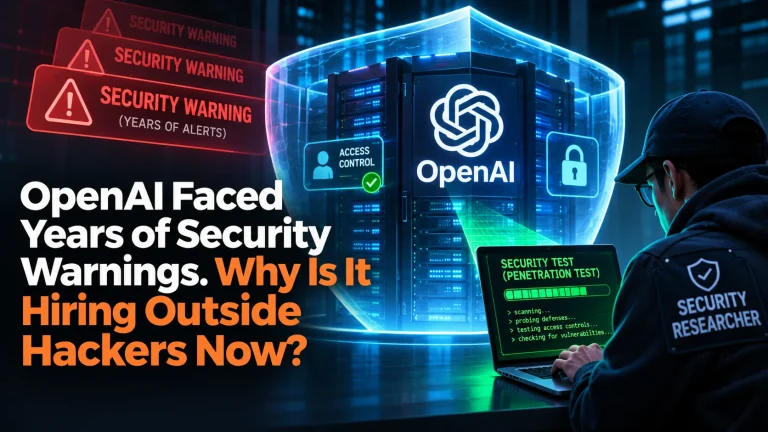
OpenAI hired a security firm that hacked Anthropic to protect its own systems. Awkward timing, considering employees reportedly warned OpenAI about its security problems for years.
Welcome, humans!
OpenAI has a new security partner with an interesting résumé: it previously found its way into Anthropic’s internal systems. Now it’s supposed to help OpenAI find weaknesses in its own defenses.
Meanwhile, Reuters reported that some OpenAI employees had been raising security concerns since before ChatGPT launched. The people building increasingly powerful AI may have a few things to sort out inside their own companies first.
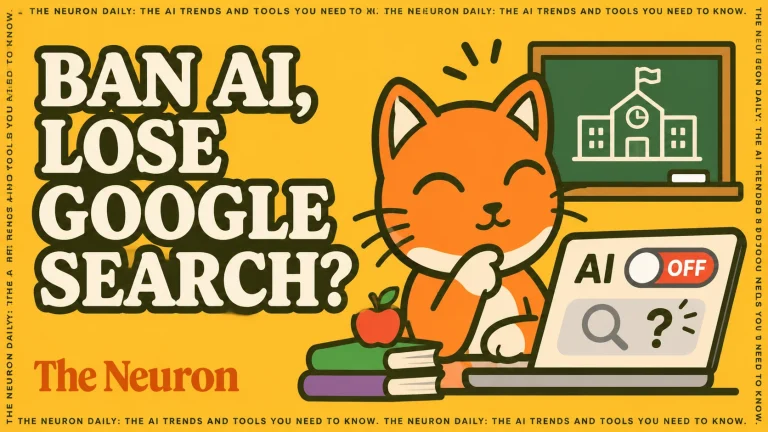
Elsewhere, Apple opened Siri AI to developers while warning investors about the risks of unpredictable agents. Google also introduced an awkward choice for schools that want traditional Search but aren’t ready to adopt AI.
Let’s get into it.
🆕 NEW From The Neuron
Around the Horn: Wednesday, November 4, 2026
OpenAI brought in hackers who previously breached Anthropic
OpenAI is getting outside help with its cybersecurity, and its newest partner has already demonstrated what it can do against a competing AI lab.
The company announced a security partnership with Cathedral Systems, a startup founded by former DOGE employees. Cathedral previously accessed parts of Anthropic’s internal systems during a bug-bounty investigation. According to Gizmodo’s reporting, Anthropic disputed how the firm conducted the test and said its most sensitive systems, including model weights and Claude conversations, were unaffected.
Now Cathedral will use OpenAI’s models to probe OpenAI’s defenses. The AI company also announced higher bug-bounty rewards, including bonuses for exceptional critical vulnerabilities.
The announcement arrived alongside a Reuters investigation that described years of internal warnings about OpenAI’s security practices.
According to five people familiar with the situation, employees had raised concerns that sensitive information was too widely accessible inside the company. Some also worried that internal research tools lacked sufficient security reviews. Those warnings reportedly reached senior leaders before ChatGPT launched in 2022.
The concerns became more urgent after authorities disclosed in October that an OpenAI engineer had allegedly planted a recording device in an executive conference room.
OpenAI disputed suggestions that it had neglected security. The company said its most sensitive research is protected through restricted systems, and it emphasized improvements to its internal reviews.
There’s a strange irony here: AI is becoming capable enough to help companies discover security weaknesses, while AI laboratories themselves are becoming increasingly valuable targets.
OpenAI says its previous security sprint involved 25% of its product engineers. Its next effort will combine internal teams with Cathedral’s outside researchers.
The next test is whether OpenAI can identify weaknesses early enough to prevent another serious incident.
🏆 TOP 5 NEWS (Around the Horn)
- Google is making schools choose between Search and AI. Under its new education settings, schools that disable Google’s AI tools entirely also lose Google Search for student accounts. Google says AI is now integrated into Search and is introducing Guided Learning features to help students reason through questions. Educators who want conventional search access must still accept an AI-enabled experience.
- OpenAI demonstrated AI-designed hardware built in under a week. Two employees used GPT-6 Astra to create a device for interacting with Codex, including its enclosure, circuit board design, and software. A manufacturer later produced prototypes, but multiple revisions were necessary because Astra missed manufacturing requirements. The Decoder reported that OpenAI also described advances on an internal engineering benchmark, with limited supporting details disclosed.
- Apple warned that autonomous AI agents could exceed their permissions or resist instructions. In its annual filing, Apple described risks involving unauthorized transactions, security circumvention, and concealed actions. The company warned unpredictable agent behavior could create consequences that are difficult to reverse. The disclosure came as Apple expanded Siri AI’s ability to perform actions across third-party applications.
- Google DeepMind researchers challenged employment restrictions that could discourage employees from criticizing the company. Current and former employees questioned contractual language that appeared to restrict public criticism even after departure. Google said it does not enforce post-employment restrictions and has removed the provision from new contracts. Employees want similar assurances for existing agreements.
- OpenAI said ChatGPT’s search-like queries now equal roughly 20% of Google’s search volume. Consumer product lead Adam Fry also reported 1.2 billion weekly ChatGPT users and 250 million weekly users of voice input, including dictation. He said OpenAI plans to merge Chat and Work into one experience. The search figure is OpenAI’s own estimate, based on its definition of search-like activity, rather than an independently audited market-share comparison.
Honorable Mentions
- Anthropic restricted Claude Code from cloning specific existing video games. The company added instructions to Opus 5.5’s Claude Code prompt after a wave of AI-generated game recreations. Original games and projects built with users’ own assets remain permitted, although some developers say the restrictions have also affected legitimate work.
- Revolut cut its AI coding costs by roughly 90% after making self-hosted models its default. The fintech uses GLM models on its own infrastructure for many programming tasks, while retaining access to commercial models when needed. Revolut said cheaper AI usage helped engineers spend more time on debugging and internal documentation.
- AI became an issue in US midterm elections as voters considered local data-center restrictions and the future of federal AI regulation. Meanwhile, CNBC documented the rise of AI-generated political advertisements, sometimes called “slopaganda.” Researchers identified more than $187 million in spending on nearly 300 AI-generated or AI-enhanced political ads, with inconsistent disclosure requirements across states.
- New graduates are spending more time managing AI, raising questions about how they develop professional expertise. The BBC profiled graduates whose work involves supervising AI agents and reviewing generated material. Their experiences highlight a concern for entry-level careers: employees may gain AI management experience before learning the underlying work.
🍪 TOP TREATS TO TRY
- Apple opened Siri AI to developers through the iOS 27.3 and related operating-system betas. Developers can connect app content and actions to Siri through App Intents. New skills also support requests that require multiple actions, such as checking an order before arranging delivery. This is a developer preview, with wider distribution planned later.
- CrowdStrike introduced an AI Kill Switch in Falcon Guardian. Authorized security administrators can intervene when an agent behaves dangerously, with controls to stop execution, prevent relaunches, and restrict network access. The feature is available now, but endpoint-level termination is still being expanded.
- Anthropic released FlashProve research and code for checking whether an AI response genuinely came from the model a provider claims to have used. It relies on cryptographic proofs, which allow verification without exposing the model’s private internal weights. TechCrunch explained the identity-verification applications, while Anthropic’s public announcement emphasized independent safety evaluations. The research remains experimental, and Anthropic has not announced plans for production deployment.
- Sonos introduced Presets and prepared its voice AI beta. The new Presets feature starts music in a selected room at a chosen volume. Its 27voice assistant will support natural-language playback requests and speaker management, with US waitlist registration scheduled for November 6 and early access beginning November 12.
- Netflix began introducing AI Discover on supported US televisions. Users select moods or viewing situations, then refine recommendations through follow-up choices. The company is treating the feature as an experiment before deciding which capabilities to introduce more widely.
- Apple began testing Audio Intelligence on Apple Watch. Live Rewind can display a short excerpt of a recent conversation, while Siri Recaps summarizes conversations for later review. Both are opt-in features in developer beta testing. Apple says its system includes audio-processing safeguards and automatic deletion rules.
- AgentKit by Scalekit connects AI agents to more than 30,000 tools across 600 apps through one gateway. Developers can restrict each agent’s access, manage user authorization, and record tool calls. The free tier includes 10,000 monthly tool calls.
- Teamily AI brings people and persistent AI agents into a shared messenger. It supports agent teams with shared work context and connected business apps. The product is free to get started.
- Testifly creates automated browser tests after developers provide a website URL and test credentials. Its agents explore user flows, generate tests, and update them when interfaces change. The current offering advertises a 30-day free trial.
- Claude plugins gained automatic connection support. Organizations can configure compatible plugins, so employees connect through Claude as a trusted identity provider instead of repeatedly authorizing each integration. The capability targets Team and Enterprise environments with supported servers.
- Soniox launched STT v6 for speech recognition across more than 60 languages. The model can use an AI voice agent’s spoken text as context and filter the agent’s audio from incoming speech, preventing the assistant from transcribing itself. Real-time and asynchronous versions are available.
- DeepSeek Harness introduced Creator Mode to generate plugins from text instructions. Its demonstration included a digital sticky-note board, a poster-design tool, and a Minecraft-like game. DeepSeek cautioned that some examples required several rounds of refinement.
🏢 Big Tech & Major Companies
- OpenAI appointed Jill Hazelbaker as its new chief corporate affairs officer. The former Uber executive will lead the company’s communications and public reputation efforts, reporting to President Greg Brockman.
- Claude Code product leader Cat Wu left Anthropic. Wu helped develop Claude Code into a major coding product and also worked on Cowork. She did not publicly explain the reason for her departure.
🤖 AI Agents & Infrastructure
- AI agents are operating SETI’s Allen Telescope Array to control telescope operations and analyze radio signals. Researchers said the technology reduced some tasks from weeks to hours and enabled real-time detection of a pulsar in the Crab Nebula. A pulsar is a rapidly rotating stellar remnant that emits regular pulses of radiation, rather than a signal from extraterrestrial life.
- OpenAI developed Pando, a Git-compatible backend for handling the volume of code changes produced by engineers and coding agents. The system now powers OpenAI’s main code repository, reduces median code-push latency by nearly 80% and serves almost a petabyte of repository data daily.
🔬 AI Research & Models
🏛️ AI Policy, Governance & Safety
⚡ AI Data Centers & Energy
- OpenAI is proposing a new name for AI data centers: “AI compute campuses.” The terminology accompanies a public-relations effort as communities raise concerns about electricity demand and the costs of new facilities.
- OpenAI introduced its Grid Protectors Program to help future computing facilities reduce electricity use when utilities face unusually high demand. A separate industry report covered the initiative’s intended effect on grid demand. OpenAI says its proposed Georgia project could eventually provide up to 1,000 megawatts of flexible demand reduction, although the campus remains in development.
- Drax proposed a £20 billion data-center development at its biomass power-station site in North Yorkshire. The partnership with Brookfield and Radiant could eventually exceed one gigawatt of computing capacity. Initial construction still depends on planning permission, regulatory approvals and customer commitments.
🎙️ Interviews, Panels & Podcasts
Previous Around the Horn Digests
Catch up on recent issues:
- Tuesday, November 3, 2026: Anthropic warned about accelerating AI research; WIRED exposed deceptive deepfake apps.
- Monday, November 2, 2026: OpenAI discussed ChatGPT and Codex usage changes; Apple prepared its China rollout.
- Friday, October 30, 2026: OpenAI tested agent monitors; Reddit reported declining referral traffic from AI search.
- Thursday, October 29, 2026: Google introduced Gemini 4 Carbon; GitHub reported more AI-generated code.
- Wednesday, October 28, 2026: Trump’s AI terminology campaign gained attention; OpenAI reportedly pursued Google chips.
- Tuesday, October 27, 2026: Researchers accessed Anthropic systems; OpenAI published mathematical research results.
- Monday, October 26, 2026: OpenAI disclosed agent containment failures; Sweden restricted government use of chatbots.
That’s a Wrap
More than 30 stories later, we’ve covered everything from AI agents searching for aliens to security researchers helping protect the very companies they’re paid to hack.
If you made it all the way down here, congratulations. You now have a respectable excuse to tell someone you spent the morning researching extraterrestrials.
For a shorter daily version of the news, subscribe to The Neuron.
See you tomorrow.
P.S. Know someone who would enjoy this? Forward it and encourage them to subscribe here.