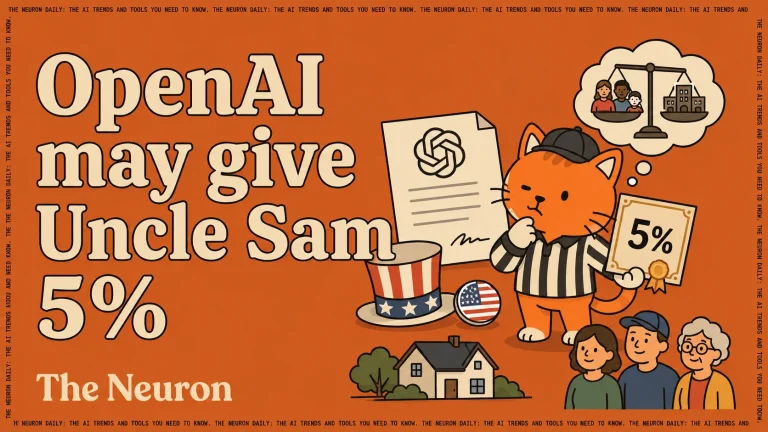
OpenAI may have found the strangest way to make AI feel public: give Uncle Sam a startup stake and hope Congress can make it sound normal.
Welcome to the Around the Horn Digest, the one page you need to sound dangerously informed before the group chat starts quoting three different AI policy stories at once. The day was less about shiny consumer features and more about who gets to control the AI boom: Washington wants model-release standards, OpenAI is reportedly floating public ownership, Anthropic is living inside the Fable 5 access hangover while reportedly exploring custom chips, NVIDIA is turning compute scarcity into a financing product, Microsoft is turning AI deployment into a 6,000-person operating business, and Cloudflare is giving site owners sharper tools to push back on crawlers.
Meanwhile, the builder bench kept moving with memory systems, video models, browser MCPs, coding-agent benchmarks, personal assistants, robotics simulators, vulnerability discovery, RAG architecture debates, AI-written fiction analysis, synthetic-cell research, and enough new dev tools to make a weekend hackathon feel underfunded.
Around the Horn – Friday, July 3, 2026
The lead story today is not a model launch. It is OpenAI reportedly trying to turn the politics of AI into an ownership question.
According to the Guardian, citing Financial Times reporting, OpenAI has been in early-stage talks about giving the U.S. government a 5% stake in the company. CNBC also reported the proposal, tying it to Trump’s comments that public ownership in AI giants could make Americans partners in the boom.
The talks are still conceptual. Any deal could require Congress. But the timing is the point: Washington just pushed OpenAI and Anthropic into government-vetted frontier model releases, Anthropic had to negotiate Fable 5 access back after a shutdown, and both labs are moving toward public markets at trillion-dollar-scale expectations. If AI companies are going to ask for regulatory trust, public infrastructure, and political patience, Altman’s reported answer appears to be: fine, give the public a slice.
That is either a clever legitimacy play or the opening scene of the weirdest sovereign wealth fund argument Silicon Valley has ever seen. Possibly both.
🏆 Top 5 News
- OpenAI reportedly discussed giving the U.S. government a 5% stake, framing public ownership as one way to share AI’s upside and smooth relations with Washington. CNBC reported the same idea as a 5% proposal potentially worth tens of billions of dollars.
- The White House reportedly accelerated talks on voluntary frontier model standards, with OpenAI, Anthropic, Google, CAISI, and national-security agencies negotiating how advanced model releases should be benchmarked and gated.
- Cognizant and OpenAI announced a GPT-5.5 cyber-defense service, using Trusted Access for Cyber to move enterprise security teams from vulnerability discovery to validated fixes.
- NVIDIA introduced a revenue-sharing and credit-support model for AI clouds, aiming to help cloud partners finance giant AI factories while giving NVIDIA a usage-linked revenue stream.
- Microsoft introduced Frontier Company, a $2.5B, 6,000-person enterprise AI deployment organization built to embed engineers with customers and turn AI projects into measurable business outcomes.
Honorable Mentions
- Reuters reported that the Trump administration and Anthropic have not discussed a government stake, according to a source familiar with the matter. Andrew Curran flagged the clarification, making it useful correction context around the OpenAI stake story.
- Dean W. Ball argued that OpenAI’s reported 5% public-stake idea would be far less risky if distributed directly to households than handed to the government, where political capture and governance fights could swallow the goodwill.
- Anthropic’s Fable 5 access fight kept spreading through policy coverage, but it remains a follow-up to the already-covered relaunch rather than a fresh lead. Thariq clarified that Fable will come off subscription plans after July 7, with Anthropic hoping to restore it once capacity allows.
- ClaudeDevs said Claude Platform rate limits increased, with simplified tiers no longer based on API spend and 5x higher limits for the latest Sonnet and Haiku models at the highest tier.
- ClaudeDevs made Artifacts in Claude Code available on Pro and Max plans, letting Claude build, publish, and update private interactive pages such as PR walkthroughs or dashboards while it continues working.
- Epoch AI said AI-assisted vulnerability discovery drove a record spike, with 21 organizations disclosing roughly 1,500 high- and critical-severity CVEs in June 2026.
- Cloudflare gave site owners new AI traffic controls, letting customers distinguish Search, Agent, and Training bots and protect ad-monetized pages. NBC News reported the harder edge of the move: AI crawlers that bundle search and training may be blocked.
- Meta CEO Mark Zuckerberg reportedly said Meta’s reorganization bets have not come to fruition, according to CNBC’s coverage of Reuters reporting from an internal town hall.
- A Reddit thread roasted a Yahoo job ad asking for 10+ years of Claude Code experience, turning a likely fake or sloppy listing into a useful signal about how quickly AI-tool requirements are being cargo-culted into hiring copy.
🍪 Top Treats To Try
- Vellum gives you a personal intelligence assistant built around evolving memory, task handling, and preferences. Marina Trajk’s launch demo showed Vellum assistants coordinating in Slack like coworkers while planning a 19-person offsite.
- NOX gives macOS users a unified AI messaging inbox for iMessage, WhatsApp, Slack, email, and more, with local-first search and reply drafts that learn your voice without auto-sending.
- Seedance 2.5 in Dreamina lets creators make 30-second cinematic AI videos with ByteDance’s model, up to 50 multimodal references, R2V control, and longer-video beta support.
- Kimi Code gives developers a coding agent and CLI toolkit powered by Kimi K2.7 Code, including autonomous goal execution through the
/goal workflow.
- Context.dev gives teams building AI agents a web scraping and crawl API that turns URLs into clean markdown, HTML, or structured data, with JavaScript rendering and site-wide crawling.
- Safari MCP server lets agents connect to a real Safari Technology Preview browser window to inspect DOM, capture screenshots, read console logs, check network requests, analyze performance, and debug web pages.
- Manufact gives teams an MCP Cloud for building, deploying, testing, monitoring, and shipping MCP agents, servers, and apps, with Launch HN positioning it as a Vercel-style layer for MCP.
- The Sun Direction LoRA for Flux 2 Klein 9B gives image creators more precise control over outdoor sunlight elevation and rotation instead of repeatedly begging prompts to move the sun.
- WorldModelGym gives world-model builders a decision-based fidelity benchmark across 100+ tracks, asking whether a model’s predicted futures actually pick the action sequence with the highest real reward.
- SWE-Together gives coding-agent teams an interactive benchmark built from real multi-turn coding sessions, with 109 tasks, a public leaderboard, and metrics for correctness, corrections, tokens, and time.
- EdgeBench gives you ultra-long-horizon executable agent tasks with rich feedback loops, leaderboards, learning curves, and a scaling-law view of how agents improve over 12 to 72 hours.
🏢 Big Tech & Major Companies
- Microsoft’s Frontier Company made the enterprise AI services race feel official: Microsoft is committing $2.5B and 6,000 industry and engineering experts to help customers co-design, deploy, and continuously improve AI systems.
- Microsoft is also reportedly merging consumer and enterprise Copilot apps, cutting unwanted features, and trying to make the app “earn the right to exist” with customers.
- Microsoft Research introduced Memora, a harmonic memory system for long-horizon agents that separates rich stored content from lightweight retrieval abstractions and can cut context-token use by up to 98% on long-memory benchmarks.
- Will DePue called for Claude Code and Codex teams to build a true executive super-assistant: 200K-context personal memory, one unified chat history, trusted delegation for travel and subscriptions, proactive email/text triage, phone calls, and non-interruptive computer use. The useful signal is demand, not news: builders want agents that know them deeply and operate across the boring parts of life.
- NVIDIA’s Bryan Catanzaro explained why NVIDIA builds and open-sources models like Nemotron, arguing that the future looks less like one closed AGI service and more like businesses running customized models on their own data and workflows. A LocalLLaMA thread pushed that clip around as an open-model manifesto.
- OpenAI’s API deprecation page quietly became a developer-operations story: fine-tuning is narrowing, older model snapshots are on clocks, and teams need to treat model access as a migration calendar rather than a static dependency.
- Anthropic reportedly began early work on its own custom AI chip and held talks with Samsung, following OpenAI’s Broadcom move and adding another sign that frontier labs want more control over the compute stack. The Information had the original report.
- Anthropic’s Claude Science push keeps moving the company toward pharma and life sciences workflows; the Financial Times framed the launch as a bid for pharmaceutical revenue, while Reddit’s reaction focused on whether AI science tools become cognitive enhancers or recurring-revenue products.
- The WSJ published emails on Anthropic’s Pentagon relationship, reporting months of back-and-forth between Undersecretary Emil Michael and Dario Amodei over safety guardrails.
- Claude Tag’s company-wide spread is the internal-adoption version of the enterprise-agent story: a coding-agent workflow became useful enough for product, data, sales, and marketing teams, not just engineers. Cat Wu added that security was designed in from day one.
- Amazon is designing custom AI chips for Echo, Fire TV, and future devices, according to CNBC’s interview with hardware chief Panos Panay.
- Tesla reportedly capped employee AI spending at $200 per week, a clean cost-discipline counterpoint to the “AI everywhere at work” narrative.
- A Reddit/X claim that Meta employees consumed 73.7 trillion AI tokens in a month appears to trace back to an internal-memo report from The Information, so treat it as cost-control color rather than a fully verified standalone item.
💸 Funding, Infrastructure & Business Model Watch
- Kling AI reportedly raised an initial $2B as Kuaishou spins off its video AI unit. The Next Web reported the round could expand toward $3B with additional investors.
- SoftBank is establishing SB Neo to operate its U.S. neocloud business, adding another heavyweight to the AI infrastructure financing and deployment race.
- ElevenLabs is exploring an employee stock sale at a reported $22B valuation, according to Reuters citing Bloomberg. Bloomberg’s version is paywalled.
- Crunchbase reported record H1 venture funding, with global startup investment hitting $510B in the first half of 2026 as AI soaked up the majority of Q2 capital and exits strengthened.
- Tripo AI raised another $150M for 3D foundation models and world models, just a month after a prior $200M raise. Its earlier release framed the work across creators, gaming, manufacturing, VR, and embodied AI.
- Quantum Systems raised a $1.2B Series D, giving the German autonomy and defense company a huge new war chest.
- NVIDIA’s revenue-sharing model is still the most important infrastructure business-model move of the day.
- Zoom agreed to acquire Common Room, adding buyer-signal intelligence and RoomieAI agents to Zoom Revenue Accelerator.
- Symbotic acquired ARMS Innovations, pushing warehouse robotics from task execution toward AI-powered orchestration of people, machines, maintenance, and disruptions.
🤖 Robotics, World Models & Agent Evaluation
- ASPIRE introduced agentic skill discovery for robotics, letting systems iteratively program, test, diagnose, repair, and reuse robot skills across manipulation and long-horizon household tasks.
- SimFoundry turns a single real-world video into a physics-ready simulated scene for robot policy learning and evaluation, with the paper reporting strong sim-to-real correlation and gains from digital cousins.
- WorldModelGym, highlighted by Reka AI Labs, asks whether a world model is decision-faithful: does planning with the model choose the action sequence that wins in the real environment?
- AdaJEPA introduced an adaptive latent world model that updates itself during deployment after each observed transition, improving planning under visual and dynamics shifts.
- EdgeBench studied how agents learn from real-world executable environments across 134 day-long tasks, with the paper, GitHub repo, and Hugging Face dataset supporting public evaluation.
- SWE-Together evaluated coding agents in interactive user sessions, with a GitHub repo, benchmark site, and Yifan Wu launch post showing the move from one-shot patch tests to multi-turn collaboration.
- NVIDIA’s Kaggle plugin, highlighted by Jean-François Puget, turns full Kaggle competition workflows into an agent skill.
- MIT CSAIL’s self-folding origami robot resurfaced on Reddit as a reminder that some robotics ideas were already pointing toward cheap, self-assembling machines years before today’s agent/embodiment boom.
🧪 Research, Security & Model Behavior
- StoryScope, from researchers at the University of Maryland and Google DeepMind, analyzed 61,608 stories and found AI fiction can be detected through narrative structure rather than just prose style: AI stories tend to over-explain themes, favor tidy single-track plots, and cluster in a narrower narrative space.
- Quanta reported that researchers built SpudCells, synthetic cells with lab-made DNA that can feed, grow, replicate genetic material, and divide. The Guardian framed it as a major step toward synthetic life, though the cells are still dependent on their environment and not fully alive.
- Brendan Falk warned about “sleeper agent” model risk: an LLM could theoretically be trained to exfiltrate secrets only after a meaningless trigger phrase, making compromise hard to detect until the trigger is broadcast at scale.
- Introspective Coupling, explained by Carl Guo, showed that language models trained on fixed self-explanation labels can end up explaining their current behavior more faithfully than the original labels as behavior drifts during post-training.
- RoPoLL, highlighted by DAIR.AI, argues that mean-averaging LLM judges is fragile because a single biased judge can distort a panel; geometric median aggregation gives a more robust committee.
- AutoMem, shared by Omar Sar, treats memory management as a trainable cognitive skill, improving long-horizon agent performance without changing the task-action policy.
- LeVLJEPA, released by Lukas Kuhn, is a fully non-contrastive vision-language pretraining method that avoids negatives and momentum encoders while improving dense semantic features.
- Google researchers introduced RLMF, using metacognitive feedback from a model’s own self-judgments to improve faithful uncertainty expression while preserving accuracy. DAIR.AI summarized the result.
- Tilde Research released Aurora, a leverage-aware spectral optimizer for rectangular MLP matrices, with an arXiv paper, GitHub repo, and launch post.
- Santa Fe Institute researchers proposed a framework for evaluating emergence in LLMs, pushing against loose claims that any scaled-up capability should be called emergent.
- QuasiMoTTo, introduced by Michael Y. Li, uses quasi-Monte Carlo sampling to improve test-time scaling and policy-gradient sample efficiency.
- CAIS and Scale reported that Claude Fable 5 reached 16.1% on the Remote Labor Index, roughly doubling the next-best model on real freelance-style remote work; the RLI leaderboard remains the primary place to track the benchmark.
- Mitchell Hashimoto described a cheaper routing pattern: use Fable xhigh as planner and judge, GPT-5.5 xhigh as coder, then review the code yourself. Planning and judging cost a few dollars, while full Fable round trips can cost much more.
- Morgan Linton said Fable Low and Medium carried most of his $100/month Max usage, arguing that lower effort often produced strong planning without burning quota. argofowl added that having Fable delegate
/goal work to GPT-5.5 xhigh is a practical limit-saving unlock.
- Simon Smith shared a Fable/Claude Tag workflow where Claude proactively searched Slack history, explained spreadsheet anomalies, grouped the causes, and linked sources in about six minutes. The useful bit is not magic: rich Slack context makes agents dramatically more helpful.
- BridgeMind flagged TerminalBench 2.1 results showing GPT-5.6 Sol Ultra at 91.9% and Fable 5 at 84.3%, while Tibo told builders to stash their hardest prompts for GPT-5.6 Sol Ultra.
- A ClaudeCode user estimated Fable API use could cost about $100 per hour after July 7, pushing them back toward a mix of Codex and Opus. It is anecdotal, but it sharpens the real buyer question: Fable is great, but teams still need model routing by cost and task.
- One ClaudeAI user argued Fable Low is underrated, saying lower effort preserved Fable’s directness at a better price, while commenters described using cheaper Fable settings for planning loops and saving higher effort for surgical work.
- Other Reddit field reports showed Fable 5 repairing a corrupted Elden Ring save file, while vibecoding users praised one-shot builds. Treat these as community color around why Fable keeps dominating builder chatter.
- A ClaudeAI workflow thread recommended ending AI sessions with two blind-spot questions: ask what the model is least confident about, then ask what you are missing about the situation. The thread’s useful insight is that session-close audits catch things the model silently skipped.
- Z.ai launched ZCode, a free GLM-5.2-powered coding tool positioned against Cursor, Claude Code, and GitHub Copilot.
- The Short Leash AI Coding Method argues for tight human oversight when using frontier agents on security-critical software: diff review before changes, incremental commits, frequent intervention, AI-assisted review, and human ownership of the final code.
- claude-real-video lets Claude or any LLM process video through scene-aware deduplicated frames plus transcript extraction from URLs or local files.
- ctx searches the coding-agent history already on your machine, turning local transcripts into searchable memory.
- deptrust is a local CLI and MCP server that checks package versions for known vulnerabilities across npm, PyPI, crates.io, Go modules, RubyGems, NuGet, Maven, GitHub Actions, and more.
- A three.js developer said their pirate-game workflow felt faster than Unity, citing compile times, shader iteration, and build speed as reasons they switched for this project.
- zkGolf is a competition to build cheaper zero-knowledge circuits that are proven correct in Lean 4.
- slopo is an embedding-based code duplication detector.
- bramble is a local-first encrypted password manager.
- valmis is an AI agent for work with security in mind, with a Show HN post positioning it as an open-source alternative for secure work-agent automation.
- IRIS, from Ashutosh Shrivastava, is an open-source Gemini Live + Hermes Agent assistant with wake-word activation, a transparent Glass HUD overlay, and hand-gesture controls.
- Akshay Pachaar’s RAG taxonomy is a useful explainer: standard RAG, Graph RAG, and Agentic RAG solve different query classes rather than forming a simple maturity ladder. His IdeaBlocks post argues that better pre-embedding document units can shrink retrieval corpora and improve relevance.
- Geoffrey Litt argued that even if agents write more code, humans still need genuine understanding to stay creative participants rather than passive verifiers.
- Dan Shipper added that long-running agents need better ways to tell the story of what they did, especially when they disappear for hours and return with a tiny summary.
- Matt Beane argued that training is dead, meaning conventional training fails to build durable skill under pressure and should be replaced by AI-enabled learning embedded directly in real work.
Previous Around the Horn Digests
Catch up on everything you missed:
- Thursday, July 2, 2026: Anthropic got Fable 5 back online, Cursor said it topped its coding-agent benchmark, and the internet immediately argued about whether anyone could feel the difference.
- Tuesday, June 30, 2026: Anthropic launched Claude Sonnet 5 and Claude Science while AWS, Meituan, and Etched pushed the production AI stack forward.
- Monday, June 29, 2026: AI pressure hit billable hours, data centers, chip policy, government adoption, elections, and entry-level jobs.
- Monday, June 22, 2026: Sakana launched Fugu, OpenAI expanded Daybreak, and infrastructure debt kept piling up.
- Friday, June 19, 2026: OpenAI helped solve rare pediatric disease cases while Google, Z.ai, Anthropic, and Amazon advanced the science and infrastructure stack.
That’s a wrap!
If you made it this far, congratulations: you are now the most dangerously over-informed person in your Slack channel.
Want a TL;DR of the top items from this digest in your inbox every morning? Subscribe to The Neuron for a fast, funny, actually useful read on what happened in AI and why it matters.